
The Implant That Monitors Blood Sugar While You Chew
In the rapidly evolving world of medical technology, continuous glucose monitoring (CGM) has become a cornerstone for people managing diabetes. Yet, despite major improvements in wearable sensors, patches, and minimally invasive devices, a major challenge remains: making glucose tracking more seamless, natural, and unobtrusive. Enter a revolutionary innovation—a tiny oral implant capable of monitoring blood sugar levels simply by analyzing your saliva while you chew.
This groundbreaking device marks the next frontier in personalized health monitoring. By leveraging biomechanics, advanced micro-sensors, and saliva chemistry, this implant represents a future where diabetes management feels effortless, intuitive, and integrated into everyday life.
How Does Chewing Reveal Blood Sugar Levels?
Chewing triggers a series of biological processes inside the mouth. Saliva glands activate, releasing enzymes, electrolytes, and biomarkers. Scientists have long known that glucose levels in saliva correlate—although less directly—with glucose levels in the blood. Until recently, however, the technology wasn’t sensitive enough to rely on saliva as an accurate measurement tool.
Modern nano-sensors have changed this. Today’s biosensors are capable of detecting extremely low concentrations of glucose and other metabolites present in saliva. When integrated into a dental implant or smart oral device, the system can:
- Capture biochemical data from saliva
- Analyze glucose patterns
- Send results to a smartphone or wearable device
The act of chewing increases saliva flow, giving the implant frequent opportunities to gather precise data.
What the Implant Looks Like
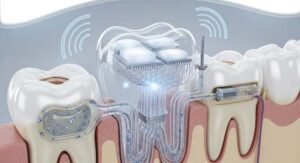
This blood-glucose-monitoring implant is typically embedded in a back molar or dental crown, blending seamlessly with natural teeth. It includes:
- Microfluidic channels that collect saliva
- Nano-biosensors that detect glucose and related chemical markers
- A tiny processing chip
- Wireless transmitters that send real-time data to a personal health app
- A long-life micro-battery or wireless charging coil
The result is a compact, durable, and biocompatible device that works continuously without interfering with chewing or speaking.
Real-Time Monitoring Without Finger Pricks
For millions of people with diabetes, finger-prick tests are painful, inconvenient, and disruptive. Even modern CGM patches require frequent replacements and can irritate the skin.
- Zero skin penetration
- Continuous, passive monitoring
- Automatic data syncing
- Minimal maintenance
- No visible equipment
Because the device is inside the mouth, it is protected from external wear and tear, providing long-term stability and accuracy.
Why the Mouth Is the Future of Health Monitoring
The mouth is one of the body’s richest sources of real-time biological information. Every time you chew, swallow, or speak, saliva circulates through the oral cavity and interacts with the tooth surfaces.
Saliva contains valuable biomarkers such as:
- Glucose
- Cortisol
- Lactate
- Electrolytes (sodium, potassium, calcium)
- Inflammatory proteins
This means an oral implant has access to a unique and continuous flow of metabolic data.
Researchers predict that in the future, dental implants may monitor not just blood sugar but also:
- Stress levels
- Hydration
- Hormone fluctuations
- Nutritional deficiencies
- Early signs of infection
The mouth could become one of the most important interfaces for preventive medicine.
Benefits for Diabetes Management
For individuals with Type 1 or Type 2 diabetes, this device unlocks several game-changing advantages:
- Improved Prediction of Glucose Spikes
Because the implant collects data throughout the day, it identifies patterns associated with meals, activity, or stress. - Better Long-Term Glycemic Control
Continuous monitoring allows diabetics to adjust their diet, insulin, and lifestyle with greater precision. - More Comfortable Than Wearables
No adhesives, no skin irritation, no visible device—just natural, discreet health tracking. - Enhanced Safety
The implant can provide early alerts for:
- Incoming hypoglycemic events
- Dangerous glucose spikes
- Unexpected fluctuations
This can be lifesaving during sleep or intensive physical activity.
Safety & Durability
Because the implant is sealed inside a dental crown or prosthetic, it is protected from saliva corrosion and mechanical wear. Most models are designed to last several years, with battery-free versions harvesting energy from chewing motion or external wireless charging.
Biocompatible materials ensure they remain safe inside the mouth without generating inflammation or allergic reactions.
A Future Beyond Diabetes
While this implant is designed primarily for glucose monitoring, the technology opens the door to a wide range of future innovations. Scientists foresee devices that can measure dozens of biomarkers at once—turning your mouth into a natural diagnostic center.
Imagine a future where:
- Your teeth monitor your metabolism
- Your crown detects dehydration
- Your dental implant screens infections in real time
- Your mouth reports early signals of chronic diseases
This is not science fiction—it is the next generation of personalized, preventive healthcare.
Final Thoughts
The implant that monitors blood sugar while you chew represents one of the most exciting breakthroughs in health technology. By transforming something as ordinary as chewing into a powerful diagnostic action, it brings us closer to effortless, continuous, and precise health monitoring.
This innovation not only simplifies diabetes management but also paves the way for smarter, more intuitive medical tools that blend seamlessly into everyday life. As technology continues to advance, we may soon find that the key to understanding our health lies right inside our mouths.
Share this :
Popular Categories
Signup our newsletter to get update information, news, insight or promotions.
Latest Post
November 22, 2025

November 22, 2025